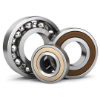





Bearings make you dizzy? A practical guide to get you into the picture.
Bearings are a key component of many industrial devices, machines, and engines. Their role is to minimize friction between moving parts, enabling smooth operation and extending the lifespan of equipment. Although bearings may seem simple at first glance, selecting the right one is often more complex than it appears.
Tapered roller bearings consist of a cup and a cone. The cup includes the outer ring, while the cone assembly comprises the inner ring, rollers, and cage. This bearing design accommodates combined loads and provides low friction during operation. By setting a single-row tapered roller bearing against another and applying preload, a rigid bearing setup can be achieved.
Spherical roller bearings are capable of compensating for misalignment, which helps reduce maintenance costs and prolong bearing life. They are designed for numerous applications, including main shafts of wind turbines, continuous casting machines, vibrating applications, and high-speed applications. Additionally, they encompass solid oil bearings, split bearings, SKF ConCentra bearing units, and a triple-barrier SKF solution suitable for the harshest operating environments.
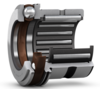
Needle roller bearings have cylindrical rollers with a small diameter relative to their length. The modified roller/raceway profile prevents stress peaks and extends the bearing’s service life.
Angular contact ball bearings are separable, meaning the washers and the ball-and-cage assemblies can be mounted independently. Although initially designed to support rotary tables in drilling rigs, they are also suitable for other applications.
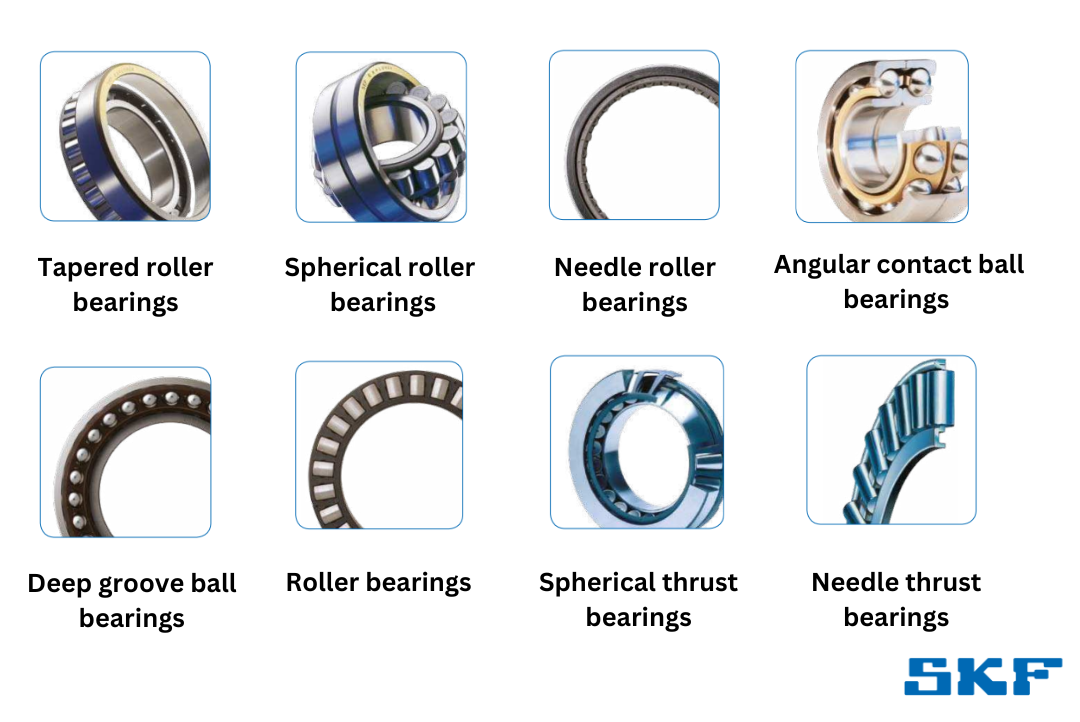
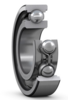
Deep groove ball bearings are the most commonly used type of bearing and are particularly versatile. They feature low friction and are optimized for low noise and low vibration, allowing for high speeds. These bearings can handle radial and axial loads in both directions, are easy to install, and require less maintenance than other bearing types.
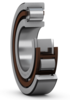
Roller bearings are available in a wide range of designs, series, variants, and sizes. The primary structural differences include the number of roller rows, the flanges on the inner/outer rings, and the design and materials of the cages.
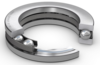
Spherical thrust bearings have specially designed raceways and asymmetrical rollers. They can transmit axial loads acting in one direction as well as simultaneously acting radial loads. The load is transferred between the raceways through the rollers at an angle to the bearing axis, with the rollers guided by a flange.
Needle thrust bearings feature a dimensionally stable cage that reliably holds and guides a large number of needle rollers. They provide high rigidity in a minimal axial space. In applications where the end faces of adjacent machine components can act as raceways, needle thrust bearings occupy no more space than conventional thrust washers.
Bearings of the SKF Explorer series - the world standard of performance and durability
Individual types of SKF Explorer bearings can be proven to offer: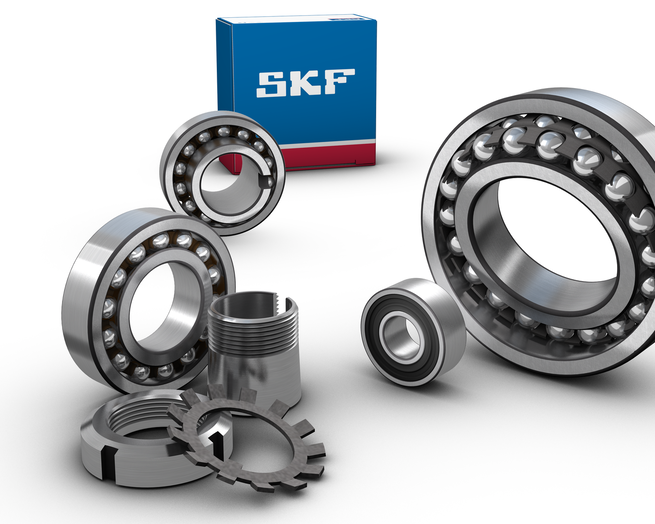
- lower vibrations
- lower heat generation
- higher load capacity, etc.
Explorer bearings are further characterized:
- higher accuracy of operation and dimensions
- optimized internal geometry
- higher quality material
- by improving the production process
What do the labels 2Z / ZZ, 2RS, or no label on a bearing mean?
The labels 2RS, RS, 2Z, ZZ, and sometimes 2Z NR are commonly encountered on ball bearings. These labels provide information about the type of sealing, which serves to protect the bearings from dirt, dust, and moisture. Selecting the correct bearing with appropriate sealing is crucial to ensure protection from external factors and proper functioning in various environments.
Bearings can have either a plastic seal, indicated by "RS." If sealed on both sides, this is indicated as "2RS." Alternatively, they can have a metal shield, indicated by "Z." If shielded on both sides, this is labeled as "2Z" or "ZZ."
- 2RS = the bearing has plastic seals on both sides (indicating "2" seals).
- 2Z / ZZ = equipped with metal shields on both sides (indicating "2" shields).
- No label (e.g., 6205) = the bearing has no seal or shield.
- 2Z N or NR = indicates a groove in the outer ring for a retaining ring. Bearings labeled "NR" are usually supplied with a retaining ring.
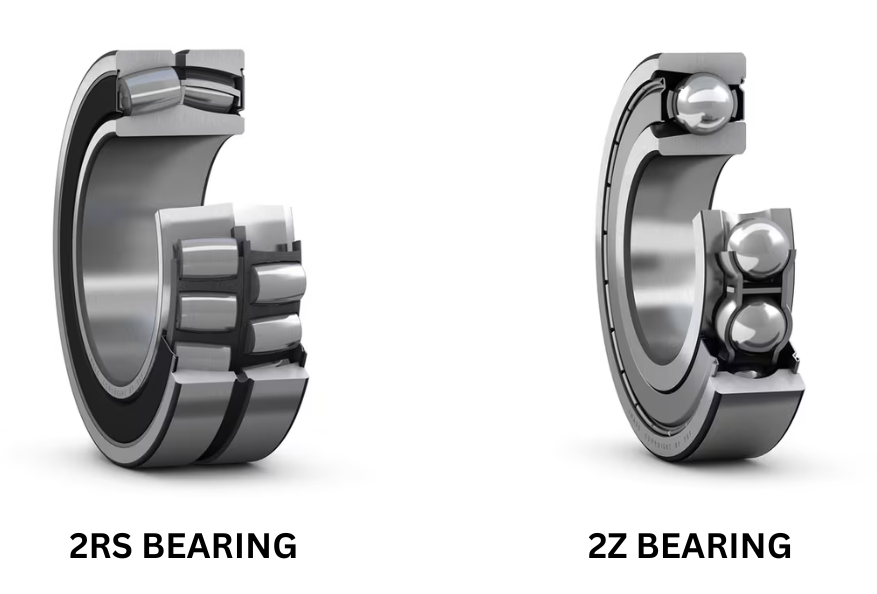
Bearings with the 2Z Label
This metal shield acts as a barrier against dirt and provides partial protection against moisture. However, metal shielding does not offer complete protection from moisture or chemicals and does not seal the bearing as tightly as a plastic seal would.
Applications of 2Z Bearings:
- They are suitable for environments with lower humidity and dust levels.
- Frequently used in equipment where there is no expectation of excessive dirt, such as clean and dry operational conditions.
- The metal shields minimize friction, allowing the bearing to reach higher speeds.
Bearings with the 2RS Label
The 2RS designation indicates that the bearing has plastic seals on both sides. Plastic seals provide better protection against moisture, dust, dirt, and even some chemicals, ensuring longer bearing life, even in more demanding conditions.
Applications of 2RS Bearings:
- Ideal for environments with higher humidity or the presence of contaminants.
- Commonly used in mechanical engineering where bearings are exposed to water, dust, or chemicals, such as in the food industry or the automotive sector.
- The plastic seal offers a tighter seal for the bearing, though it may slightly increase friction, resulting in slightly lower speeds.
- Sealed bearings contain grease, which generally lasts for the lifetime of the bearing under normal operating conditions. This makes sealed bearings nearly maintenance-free, keeping service and lubricant costs low. However, the design allows for re-lubrication if needed.
When selecting a bearing, always consider the working conditions to ensure the long life and reliable operation of your equipment.


